
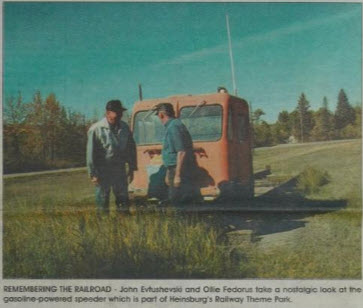
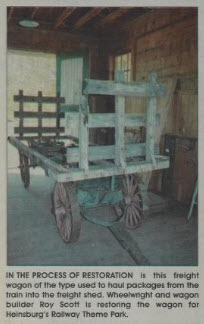
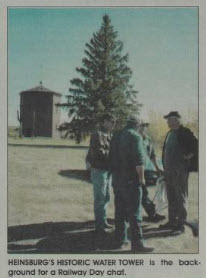
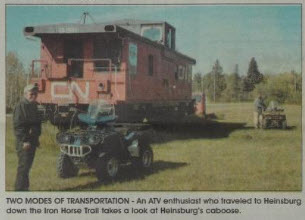
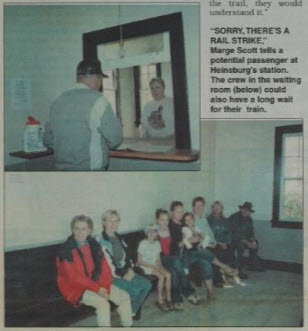
Heinsburg Community Club and the Elk Point Historical Society joined forces Sunday to look back at the era when Heinsburg was the easternmost terminus of the railway line originating in Edmonton. Visitors toured the long vacant CN station, where Community Club volunteer Marge Scott presided over the ticket window in the long-benched waiting room and led tours though the four room living quarters, the baggage room and the freight shed. She pointed out the scales salvaged from one of Heinsburg’s main street businesses and said the freight cart, which was found loaded with tires out Side a service ‘station, is soon to be refurbished by her husband Roy. Outside the freight shed, a gleaming buckboard was loaded with antique trunks and luggage of the steam train era. Younger visitors were eager to hop into the gas powered “speeder” which sits at one end of the length of track in Heinsburg’s Railway Theme Park, while all ages clambered aboard the big red caboose at the other end. The caboose, donated a few years ago by the Elk Point Historical Society, is soon to be refurbished with new paint and a general cleanup. Some even made the climb into the caboose’s cupola for a trainman’s view of the community from its second-storey windows. At the far end of the park local historian Bob Hendriks was conducting tours of the historic water tower, which is the pride of Heinsburg, since its restoration last year.
Following a barbecue lunch, visitors gathered to hear about the history of the railroad which served Heinsburg in its heyday, and listened to recollections of life along the railroad. The Coronado line reached St. Paul in 1921, but was not extended to Elk Point until 1926 and Heinsburg in 1927. Marvin Bjornstad told the group that original plans for the line would have taken it straight east from St. Paul to the Ferguson Flats area, with a divisional point at Frog Lake and the line continuing east to Onion Lake and Frenchman Butte. Many settlers made their homes in the area along the proposed route, but a second survey in 1924 moved the line south to travel through Elk Point and Mooswa (now Lindbergh) to the end of: the steel at Heinsburg. Stories of the building of the line came from historical writings of Neal Edwards and Steve Andrishak. Horse-drawn scoops called fresnos did much of the work, while an elevator grader drawn by 56 horses helped to move 1200 yards of gravel per day by loading it into the dump wagons which hauled the material onto the line where it was spread and tamped.
Steve Andrishak was seven years old: when the work crews moved to the gravel pit west of Elk Point, and recalled visiting many times and being fascinated with the massive steam shovel’ and the _ project supervisor’s tame bear. Andrishak said construction progress was amazingly rapid, with the “loud, shrill whistle” of the first train on September 22, 1927 greeted by “many happy people.”
Many trains of the day were pulled by the 46-ton Consolidated locomotive which burned 22 tons of coal, all pitched into the 8 by 15 foot firebox by a fireman with a #8 scoop shovel, on a single trip to Edmonton if it was pulling a heavy load.
Local historian Bob Hendriks told the crowd about the buildings and equipment which make up today’s theme park. The water tower was completed in 1930 and is the only 60,000-gallon water tower in the province that remains on its original site. The caboose is of 1976 vintage and spent some years on a coal train hauling from Tumbler Ridge, BC. Because it also spent some time on _ the Georgia Line in the US, it has bullet-proof glass, necessary because of an unfortunate habit of pranksters who take potshots at trains.
Speeders were often used in the early days to transport expectant mothers to hospital, as well as for their railway checking duties.
Heinsburg’s station was built in 1950, a CN Class 4A structure 40 feet by 60 which cost approximately $25,000 to construct. It is scheduled to receive a new roof in the near future and the community hopes to _ eventually develop it into a museum and tea house.
Recollections of life along the railroad and working on the railroad were also part of the day, with stories of riding the train alone at age 5, riding the train from Heinsburg to Ashmont each week to attend high school with boarding facilities, and of working on the railroad as a section man. Ken McManus, originally from Owlseye and a telegrapher in 103 railway stations during his career, said he is “still in love with trains, or I wouldn't be here.”
Roy Scott's father worked on the railway as a blacksmith, his uncles worked on the building crew and his aunt worked in the cookhouse. Ron Onusko’s grandfather was part of a group of 30 farmers from Redwater who in 1898, walked to Fernie, BC to work on the building of the railway.
Just over 50 people attended the event, including a large contingent who traveled down the Iron Horse Trail on ATVs. One man said he was “truly inspired by the trip. What has been done here is just marvelous. It is a gift to all of us. If more people did the trail, they would understand it.”