
BY ROBERT W. HENDRIKS Review Contributor
By 1905 the 75,000 square miles of land now named Alberta had largely been surveyed. Records show that as early as 1883, the Dominion Land Surveyors (D.L.S) had completed their initial work in the Heinsburg area, so with Treaty 6 land settlement involving local First Nations peoples residing here also well in place, the area opened up for settlement. Newcomers full of spirit and excited about free land began flooding in, one of them being Texan John Heins, who in 1910, travelled north from the rail line to Kitscoty, then crossing the North Saskatchewan River, using the new Lea Park ferry operated by Métis Louis Patenaude. Heins picked up the old trail above the river, then headed west, accompanied by the Thombs family, also Texan, not stopping until he had reached a point about eight km north of the river, this property now identified by a trailer court occupying its southern boundary. Why did he choose this spot? It is not known whether he had filed earlier for a homestead on his quarter - land records would tell us that - but it could be that this land had not yet been claimed. The location was choice as it was on high ground, the land arable, close to three scenic lakes lively with pike and perch and with an ample supply of timber nearby. It was also more or less equidistant from other recently established places like Kitscoty, Vermilion, St. Paul de Métis and Cold Lake, suitable for local trade so Heins opened a store and set up the area’s first post office, named (Heins)burg. This location would have been ideal because a railroad planned by the C.P.R. would have passed nearby, but that company dropped the idea and the C.N.R. slid in later with their route surveyed close to the river, with a station built at a spot carefully chosen by railroad magnates. For reasons unknown to this writer, John Heins sold out in 1919, leaving the country but within nine years of his departure, Heinsburg was relocated to where it is today.
It’s interesting to note that others had been here before Heins, at least 200 years earlier, most of them travellers passing within a scant kilometre of Heins’ land on what was known as the north branch of the lengthy Fort Gary/ Fort Edmonton Trail. This old route, locally referred to as the Victoria Trail or Fort Pitt Trail, is still visible today, skirting the south edge of Ross Lake, cutting across the sand plains south of Whitney Lake, the high flat sometimes used in much earlier times by young Aboriginals anxious to show off fast buffalo runners, then passing along the western edge of Whitney Lake, continuing on to St. Paul de Metis, Saddle Lake and beyond. These travellers were an interesting blend of Aboriginals, among them Chief Big Bear and early Métis freighters, European traders such as HBC Chief Factor John Rowand, missionaries including Father Lacombe and later, in 1885, the Alberta Field Force, part of the Canadian Militia on their way to Frog Lake and points east. They were not interested in settlement, but they liked it here as noted in their diaries and some would later return to settle.
By 1928 the Canadian National Railroad had laid steel at the new Heinsburg and the lighthearted attempts by early entrepreneurs such as Fullers to create a settlement on the riverbank began in earnest. Over the next few decades Heinsburg grew as a commercially successful and pleasant place to live.
No place is without it colorful characters who create the rich cultural fabric of any community, and Heinsburg was no exception. Among many two men come to mind, a man who in 1936 – 1937 operated a drug store in Heinsburg. He was William Bleasdell Cameron, one of the white survivors of the 1885 Frog Lake Troubles (Frog Lake Massacre) and who wrote a book about his adventures originally named The War Trail of Big Bear, then later renamed Blood Red the Sun. (W. B. Cameron’s official biography has been written by Robert W. Hendriks and published by Athabasca University. It’s scheduled for release in November, 2008.)
The other person, lesser known, was Hugh (H.C.) Graham, who lived about a mile east of the Heinsburg Community School on the flat above the river. He must have known Cameron in that Graham had served as an officer during the North West Rebellion with the London, Ontario-based 7th Battalion Fusiliers. It is said that Graham was one of several Fusiliers who escorted Louis Riel to Regina for the trial. While living near Heinsburg, he was very active in helping farmers organize the early UFA and his wife Martha was also involved in forming the first Women’s Institute. (Of note is that the 7th Battalion Fusiliers are finally being recognized for their valiant efforts in transporting huge amounts of militia supplies from Swift Current to Saskatoon by barge on the shallow South Saskatchewan River during the rebellion.)
Two interesting men also added flavour to this community, here picked at random from the many who formed the social structure of this town. There was Louis Kapjack, local store owner and hunter, his favourite weapon for game birds an 8-gauge shotgun, akin to a small cannon and deadly, so if a bird, even large like the Canada goose, was unlucky enough to be hit, it is said there was little left to eat.
Then there was a bachelor, George Botting, noted for his impromptu cooking sprees “done his way”. One of his specialities was a Scandinavian flatbread known as lefse, in what usually turned out to be a messy, labour-intensive task often assisted by unsuspecting relatives. What still brings chuckles to many who knew him was his method of storing this bread. To keep it from drying out, he would roll it up in his long underwear.
But the economic woes that shut down many prairie towns in the last half century also hurt Heinsburg. Dwindling farm populations, less employment, better highways, the new Heinsburg bridge (1963) carrying fast traffic past town and over the river, withdrawal of railroad service and destruction of the three grain elevators effectively killed trade and growth but fortunately a community spirit has survived, kept alive by the small but active Heinsburg Community Club, still strong 80 years later, still busy putting on community events.
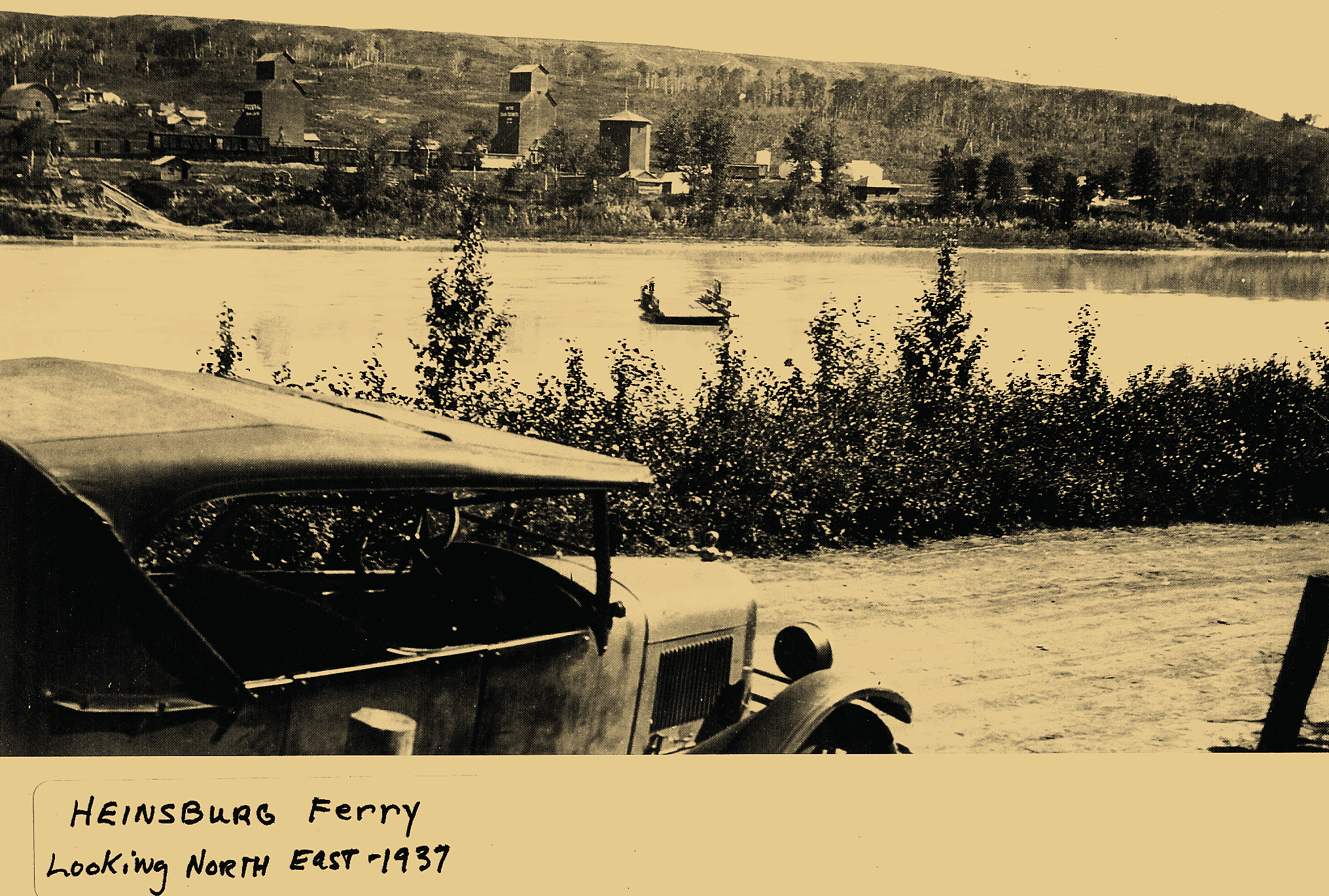
Heinsburg in 1937 from ferry landing
What lies ahead over the next 80 years? In the beginning no one could honestly predict what would happen during its first eight decades but now we know. Even after all of the ups and downs, the community is still here so chances are good that it will also be here during the next eight decades.